
BRISL Participates in the 10th Maritime Silk Road Port Cooperation Forum 2026: Advancing Dialogue on ESG, Maritime Law, and Equitable Decarbonization.
The 10th Maritime Silk Road Port Cooperation Forum (MPF 2026), one of Asia’s leading maritime dialogue platforms, was successfully held in Ningbo, Zhejiang Province, from 26–28 May 2026. Celebrating its tenth anniversary, the forum brought together more than 1,000 participants from over 70 countries and regions, including representatives from governments, international organizations, port authorities, shipping companies, academic institutions, and legal practitioners. Over the past decade, the forum has evolved into a significant platform for international cooperation and policy exchange within the global port and shipping industry. Discussions this year focused on supply chain resilience, green and low-carbon development, smart innovation, and the future of maritime services.
Hosted in Ningbo, home to the world-renowned Ningbo-Zhoushan Port, the forum reflected the growing importance of maritime connectivity under the 21st Century Maritime Silk Road framework. A series of high-level conferences, thematic forums, and specialized industry dialogues examined the challenges facing the maritime sector amid geopolitical uncertainty, climate commitments, digital transformation, and evolving regulatory requirements.
Port and Shipping Law Forum Focuses on ESG Governance
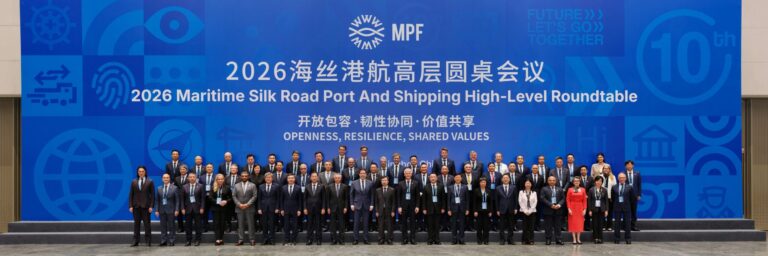
Among the key parallel events was the Port and Shipping Law Forum, held on 28 May at the Ningbo International Conference Center. The forum attracted more than 300 experts and industry representatives from over 30 countries and regions, focusing on the theme: “Harmony and Coexistence: Integration of Law and Business and Legal Safeguards for Ports and Shipping under the ESG Framework.”Jointly organized by the Zhejiang Provincial Department of Justice, Zhejiang State-owned Assets Supervision and Administration Commission, Zhejiang Seaport Group, and Ningbo Zhoushan Port Group, the forum explored the legal implications of ESG-driven transformation within the maritime industry. The discussions addressed emerging challenges in cross-border compliance, ESG disclosure obligations, legal risk management, maritime dispute resolution, and regulatory harmonization. Participants emphasized the growing convergence between commercial operations and legal governance as environmental and sustainability requirements become increasingly embedded within maritime business models. The forum also witnessed the launch of several important legal and compliance initiatives, including:
- The formal operation of a high-standard integrated maritime dispute resolution center jointly established by Zhejiang Maritime Safety Administration and Ningbo Maritime Court.
- The publication of the “Ningbo Foreign Economic and Trade Country Legal Risk Research Report.”
- The promotion of China’s national standard on the effectiveness evaluation of compliance management systems (GB/T 47432-2026).
Distinguished Speakers Address the Future of Maritime Legal Governance
The keynote session featured prominent figures from the judiciary, international organizations, academia, and maritime legal practice. Among the notable presentations:
- Pan Yongfeng, Deputy Director of the Fourth Civil Division of the Supreme People’s Court of China, examined how maritime judicial reforms can support the green transition and modernization of the shipping industry.
- Ren Weimin, Director of the Transport Division of the United Nations Economic and Social Commission for Asia and the Pacific (UNESCAP), highlighted the evolution of ESG from a sustainability-centered framework toward a resilience-driven governance model, emphasizing the need to integrate ESG considerations into everyday business operations.
- Ryu Dong-jin, President of Korea Maritime and Ocean University, shared Korea’s experience in maritime legal innovation and discussed the strategic role of international maritime courts in supporting sustainable maritime development.
- Cai Chenfeng, Director of the Commercial and Maritime Law Center of the China Council for the Promotion of International Trade (CCPIT), explored how modern maritime legal services can facilitate ESG transformation and contribute to China’s broader maritime development strategy.
- Professor Zhu Zuoxian, Dean of the Law School of Dalian Maritime University, presented an analysis of legislative models concerning port operators’ civil liability and future directions for maritime law reform.
- Li Lianjun, Honorary Legal Advisor to the Hong Kong Shipowners Association, reviewed recent developments in international maritime arbitration and emerging innovations within China’s arbitration framework.
Collectively, these presentations underscored the increasing importance of legal certainty, compliance mechanisms, and dispute resolution frameworks in facilitating the maritime industry’s transition toward sustainability.
International Dialogue on ESG and Cross-Border Compliance
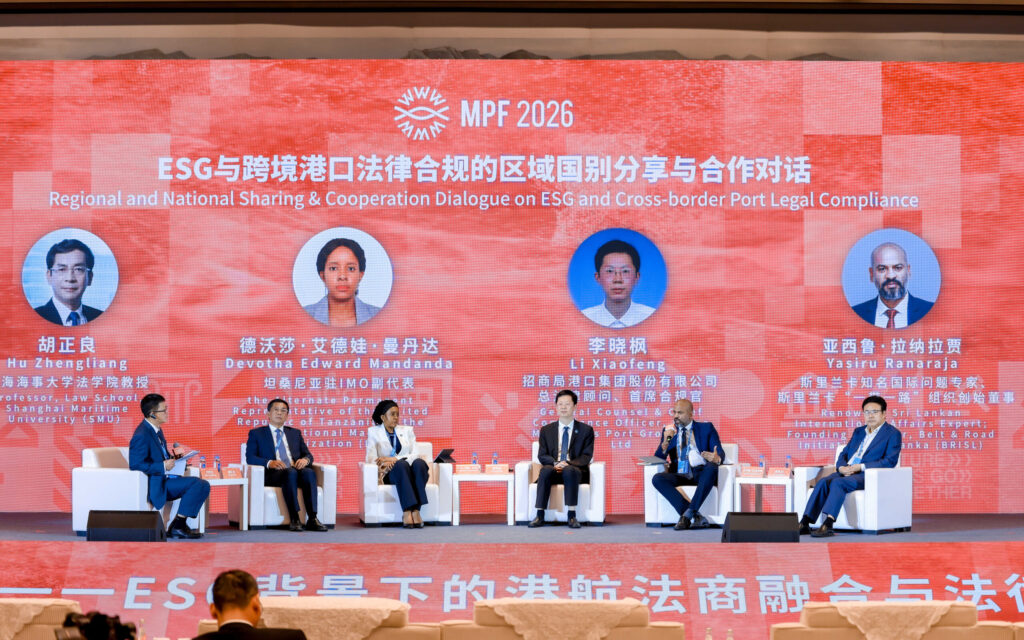
One of the most anticipated segments of the forum was the special dialogue on: “ESG and Cross-Border Port Legal Compliance: Regional Experiences and International Cooperation.” Moderated by Wan Xuezhong, Deputy Editor-in-Chief of Legal Daily, the panel brought together experts from multiple jurisdictions, including:
- Professor Hu Zhengliang, Shanghai Maritime University;
- Devotha Aidha Mandanda, Alternate Representative of Tanzania to the International Maritime Organization (IMO);
- Li Xiaofeng, General Counsel and Chief Compliance Officer of China Merchants Port Holdings;
- Yasiru Ranaraja, Founder Director of the Belt & Road Initiative Sri Lanka (BRISL);
- Xu Yongqian, Senior Partner at Dacheng Law Offices and recipient of the 2023 China ESG Person of the Year award.
The discussion explored ESG implementation, environmental sustainability, maritime legal governance, green port development, shipping decarbonization, and the challenges associated with cross-border regulatory compliance. Participants shared experiences from different jurisdictions and emphasized the importance of transforming legal compliance from a regulatory burden into a strategic enabler of international trade and investment.
BRISL Calls for Harmonized Environmental Governance in Maritime Decarbonization
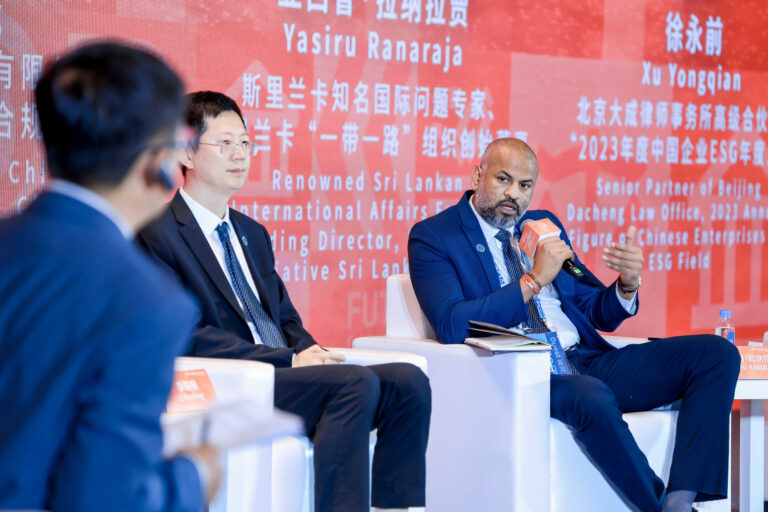
Representing BRISL, Yasiru Ranaraja delivered remarks focusing on the intersection of ESG governance, carbon pricing mechanisms, maritime law, and global economic equity. His intervention emphasized that the maritime industry is entering an unprecedented era of environmental safeguards and regulatory transformation. While supporting global efforts to reduce greenhouse gas emissions, he highlighted the importance of ensuring that environmental policies are implemented through harmonized legal frameworks that do not disproportionately burden developing economies.
Drawing on recent developments within the International Maritime Organization’s Marine Environment Protection Committee (MEPC), Mr. Ranaraja examined the growing role of carbon pricing mechanisms, emissions trading systems, fuel-intensity regulations, and ESG disclosure requirements. He argued that ESG has evolved beyond voluntary corporate reporting and is increasingly becoming an enforceable economic and legal framework that directly affects shipping costs, maritime finance, port competitiveness, and international trade.
A central theme of his remarks was the emerging challenge of balancing environmental ambition with economic justice. He noted that many developing countries remain heavily dependent on maritime trade while lacking access to green shipping infrastructure, alternative fuels, and ESG compliance systems. Without adequate support mechanisms, decarbonization policies risk creating a new maritime divide between developed and developing economies.
Mr. Ranaraja further highlighted the growing fragmentation of maritime regulation through overlapping compliance systems, including regional emissions trading schemes, fuel standards, carbon-intensity indicators, and port-level ESG requirements. Such fragmentation, he argued, increases legal uncertainty for shipowners, ports, insurers, and cargo interests. In response, BRISL advocated for:
- Greater harmonization of international environmental and maritime regulations;
- Technology transfer and capacity-building initiatives for developing economies;
- Equitable distribution of revenues generated through carbon-pricing mechanisms;
- Expansion of green shipping corridors as cooperative pathways toward decarbonization;
- Stronger multilateral cooperation within the IMO framework to ensure consistency and legal certainty.
According to BRISL, the ultimate success of maritime decarbonization will depend not only on technological innovation and environmental targets but also on the ability of the international community to reconcile climate objectives with principles of fairness, inclusiveness, and shared responsibility.
Green and Intelligent Shipping Development Closed-Door Seminar
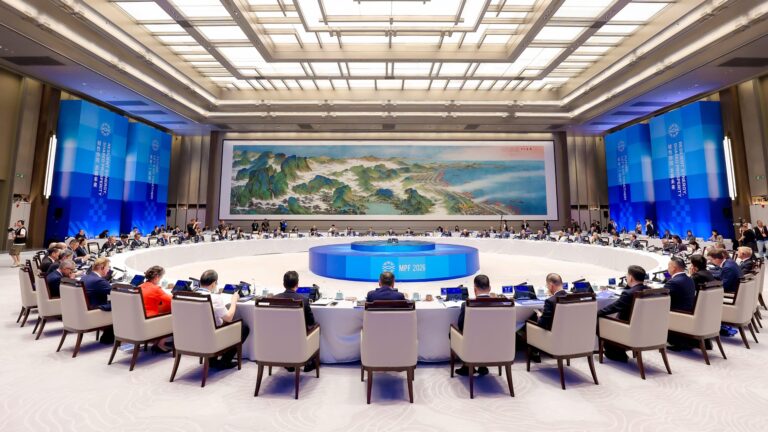
In addition to the legal forum, MPF 2026 also hosted the Green and Intelligent Shipping Development Closed-Door Seminar, which brought together more than 40 representatives from shipbuilding, maritime technology, classification societies, shipping operators, and related industries. The seminar focused on accelerating the transition toward electric and intelligent vessels, addressing challenges related to technology development, safety regulation, charging infrastructure, commercial viability, and standardization. Industry experts examined:
- Priority deployment scenarios for inland and coastal electric vessels;
- Standardization of charging and battery-swapping systems;
- Development of maritime energy supply networks;
- Innovative business models and industrial ecosystem cooperation.
Participants agreed that green and intelligent ships represent a strategic pathway toward the future of maritime transport and that stronger collaboration across industry, government, and research institutions will be essential to support large-scale implementation.
Looking Forward
The 10th Maritime Silk Road Port Cooperation Forum demonstrated the increasing interconnectedness of maritime law, environmental governance, technological innovation, and international cooperation. As shipping moves toward a low-carbon future, forums such as MPF provide an important platform for dialogue between policymakers, industry leaders, legal practitioners, and academics. For BRISL, participation in the forum reinforced its commitment to promoting balanced and inclusive maritime governance, supporting sustainable development, and ensuring that the global energy transition in shipping remains both environmentally effective and socially equitable.
As the maritime sector enters a new era shaped by ESG obligations, carbon pricing, and legal transformation, the need for harmonized regulation and international cooperation has never been greater.
end.
