Ports Connecting China and Sri Lanka: BRISL Highlights the Historic Bond Between Ningbo and Colombo
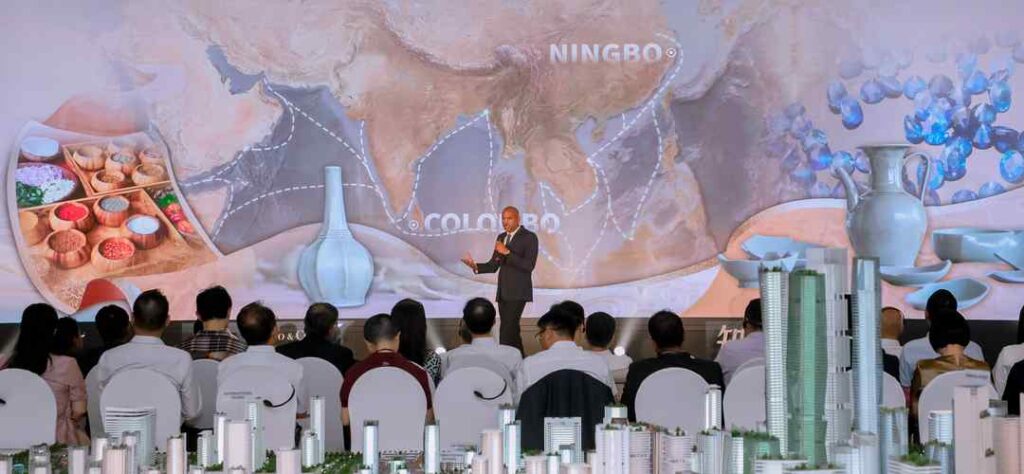
The Belt & Road Initiative Sri Lanka (BRISL) was honoured to participate in the “Kindred Spirits – Ningbo and Colombo Twin Cities Storytelling Event,” held at Colombo Port City to celebrate the establishment of the sister-city relationship between Ningbo and Colombo. Bringing together representatives from China and Sri Lanka, the event highlighted not only the enduring historical ties between the two countries but also the growing importance of city-to-city diplomacy in advancing regional connectivity, economic cooperation, and people-to-people exchanges. As an independent international development organization dedicated to promoting research, dialogue, and practical cooperation under the Belt and Road Initiative, BRISL has consistently advocated for strengthening institutional and people-centred networks across South Asia and the wider Indo-Pacific. The invitation extended to BRISL Founder Director Yasiru Bandara Ranaraja to deliver the keynote address reflected the organization’s continued engagement in fostering academic, policy, and commercial partnerships between Sri Lanka and China.
Ports at the Heart of Asia's Maritime Future.
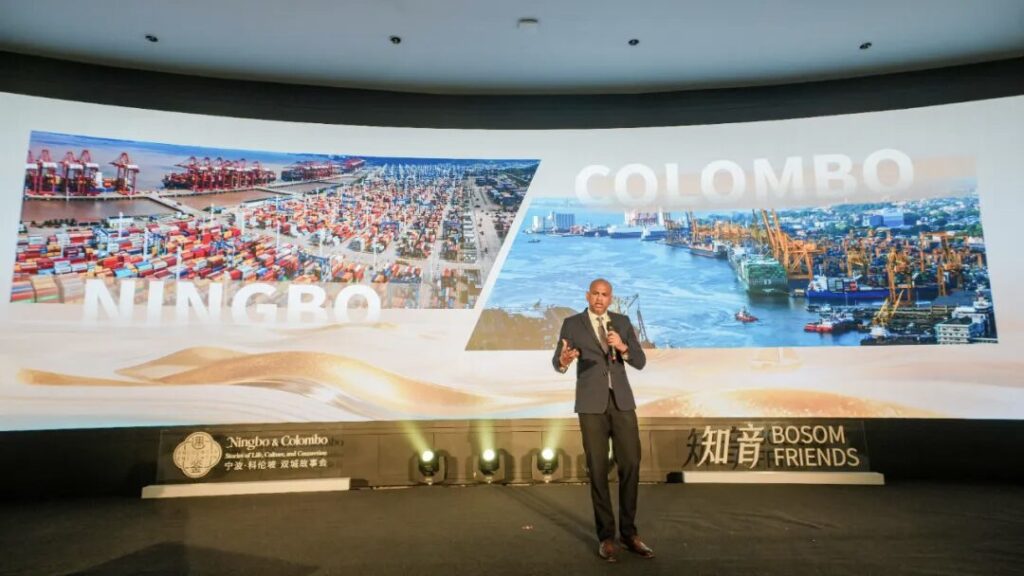
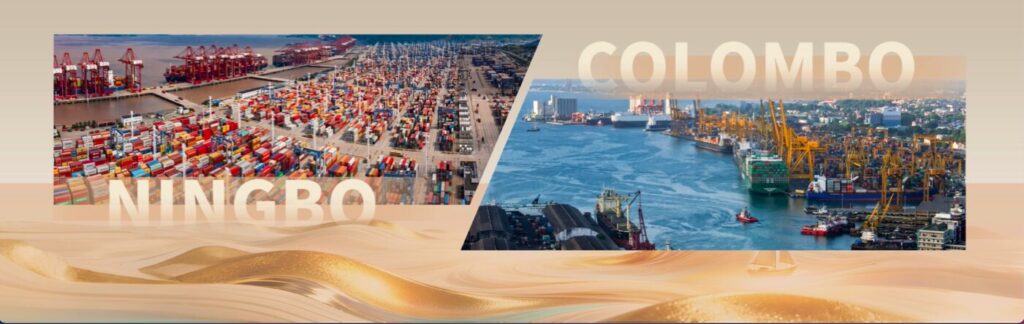
The designation of Ningbo and Colombo as twin cities carries significance far beyond municipal cooperation. Both cities occupy strategic positions along the maritime trade routes that have connected East Asia with the Indian Ocean for well over a millennium. Today, they continue to serve as indispensable gateways linking global supply chains, regional commerce, and international investment. Colombo has long been recognised as South Asia’s premier transshipment hub. Located at the crossroads of the East-West shipping route, nearly every major container service passing through the Indian Ocean calls at the Port of Colombo. Its geographical position, combined with decades of investment in port infrastructure, has enabled Colombo to become the busiest container port in South Asia and one of the leading logistics centres in the Indian Ocean. With the continued expansion of the Colombo Port City project, the development of the West Container Terminal, and complementary investments in logistics, finance, and digital infrastructure, Colombo possesses the potential to evolve into one of the world’s leading integrated maritime and financial hubs.
On the opposite side of Eurasia, the Port of Ningbo-Zhoushan represents one of the greatest success stories of China’s reform and opening-up. Following the integration of the ports of Ningbo and Zhoushan in 2005, and subsequent rounds of institutional and operational reforms, including the establishment of the Zhejiang Seaport Group in 2015—the port has transformed into the world’s busiest port by cargo throughput. For seventeen consecutive years, Ningbo-Zhoushan has maintained its position as the world’s largest port by cargo volume while consistently ranking among the world’s leading container ports. Today, it serves as a critical gateway connecting China with markets across Asia, Africa, Europe, and beyond.Together, Colombo and Ningbo-Zhoushan illustrate how strategic port development can reshape regional economies, facilitate international trade, and create new opportunities for sustainable growth.
A Maritime Friendship Rooted in History.
In his keynote address, Mr. Ranaraja reminded the audience that the partnership between Ningbo and Colombo is not a new chapter, but rather the continuation of a relationship shaped over centuries. Historically known as Mingzhou, Ningbo was one of the principal ports of China’s Maritime Silk Road during the Tang, Song, and Yuan dynasties. While vessels departed from several major Chinese ports before crossing the Indian Ocean, Ningbo remained an essential eastern gateway connecting China with overseas markets. Archaeological discoveries across Sri Lanka continue to provide tangible evidence of these historical exchanges. Chinese Yue Kiln celadon ceramics produced in the region surrounding present-day Ningbo have been unearthed at several archaeological sites, demonstrating that commercial interaction between China and Sri Lanka flourished many centuries before the modern era.

The keynote further highlighted the journey of the renowned Chinese Buddhist monk Fa Xian, who spent nearly two years in Sri Lanka during the early fifth century studying Buddhist scriptures before returning to China by sea. His voyage represents one of the earliest documented maritime connections between the two civilizations and illustrates the long-standing role of the Indian Ocean as a corridor for knowledge, religion, and cultural exchange. Mr. Ranaraja also referred to Chinese historical sources such as Lingwai Daida, Zhu Fan Zhi, and the fourteenth-century travel account Dao Yi Zhi Lue by Wang Dayuan, all of which describe Sri Lanka as an important destination within the Indian Ocean trading system. These records highlight the island’s reputation for precious gemstones, pearls, spices, and its strategic location along regional maritime routes.
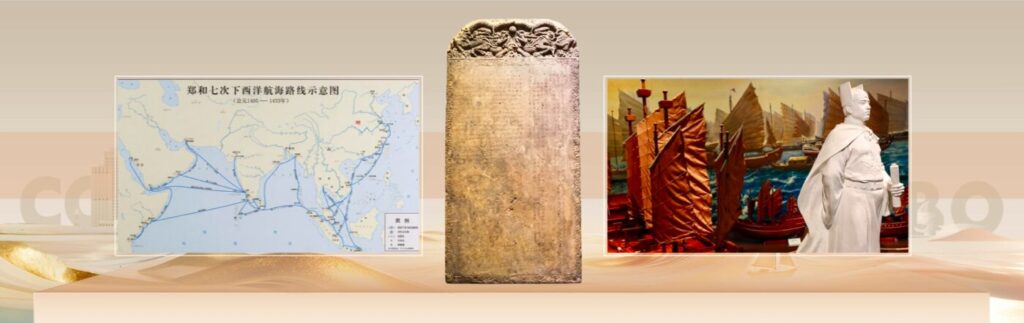
Perhaps the most enduring symbol of this shared history remains Admiral Zheng He’s Trilingual Inscription, erected in Sri Lanka in 1409 during the Ming Dynasty. Written in Chinese, Tamil, and Persian, the inscription honours Buddhism, Hinduism, and Islam simultaneously, symbolising peaceful engagement, intercultural dialogue, and mutual respect. Unlike many maritime encounters elsewhere during this period, Zheng He’s voyages demonstrated a model of exchange based upon diplomacy, commerce, and coexistence rather than conquest. More than six centuries later, the monument continues to serve as a powerful reminder of the values underpinning China-Sri Lanka relations.
Connecting the Past with the Future.
The keynote concluded by linking this shared maritime heritage with the evolving partnership under the Belt and Road Initiative. Modern container vessels have replaced the sailing ships of previous centuries, yet the fundamental role of ports as bridges between civilizations remains unchanged. Today, the Port of Colombo facilitates the movement of goods throughout South Asia, while Ningbo-Zhoushan connects Chinese manufacturing with markets around the world. Together with Hambantota Port and Colombo Port City, these developments demonstrate how maritime infrastructure can contribute not only to economic development but also to regional stability, connectivity, and shared prosperity.
The Ningbo-Colombo twin-city partnership therefore represents more than a symbolic cultural initiative. It provides a platform for expanding cooperation in maritime logistics, sustainable port development, trade facilitation, innovation, tourism, education, and academic exchange. Such partnerships reinforce the growing importance of sub-national diplomacy in complementing traditional state-to-state relations.
BRISL's Continuing Commitment.
As a Sri Lankan international development organization committed to advancing high-quality Belt and Road cooperation, BRISL views the strengthening of maritime partnerships as an essential pillar of regional development. By promoting dialogue among governments, academia, industry, and civil society, the organization seeks to contribute to a more connected Indian Ocean region founded on mutual respect, sustainable development, and shared opportunity. The “Kindred Spirits – Ningbo and Colombo Twin Cities Storytelling Event” served as a timely reminder that the oceans connecting China and Sri Lanka have never been barriers, they have always been bridges. The formal recognition of Ningbo and Colombo as twin cities marks another milestone in a relationship that spans more than a thousand years, while opening new avenues for cooperation in the decades ahead.
As Mr. Ranaraja concluded in his keynote, ports may evolve, ships may become larger, and technologies may transform global trade, but the enduring spirit of friendship and connectivity between China and Sri Lanka continues to sail across the same blue ocean that has united both nations for centuries.
