The Indian Ocean Risk
During the wars of the French Revolution (1792–1801), the British East India Company seized control of Sri Lanka—then known as Ceylon—following the fall of the Netherlands to French forces. Fearing Napoleon’s potential expansion into the Indian Ocean, the British launched a preemptive move from India to secure the island.
Throughout history, nations like Sri Lanka have endured uprisings by global powers and have often become war zones. In the post-colonial era and during the Cold War from 1947 to 1991, developing nations led the non-aligned movement. This movement consisted of a group of member states that remained independent in global issues involving the United States and the USSR. With 120 member states, the Non-Aligned Movement became the largest grouping, representing nearly two-thirds of the United Nations members and comprising 55% of the world population.
The current development of China and India, as well as the growing alliance between India and the U.S./Indo-Pacific, QUAD, etc., will result in increased naval activities. Consequently, the Indian Ocean will face similar situations as the Yuan Wang 5. Presently, the U.S. and India are finalizing an agreement to repair U.S. Navy vessels in Indian ports. Meanwhile, Pakistan is expanding its military power in the Indian Ocean, and the South China Sea is plagued by ongoing disputes.
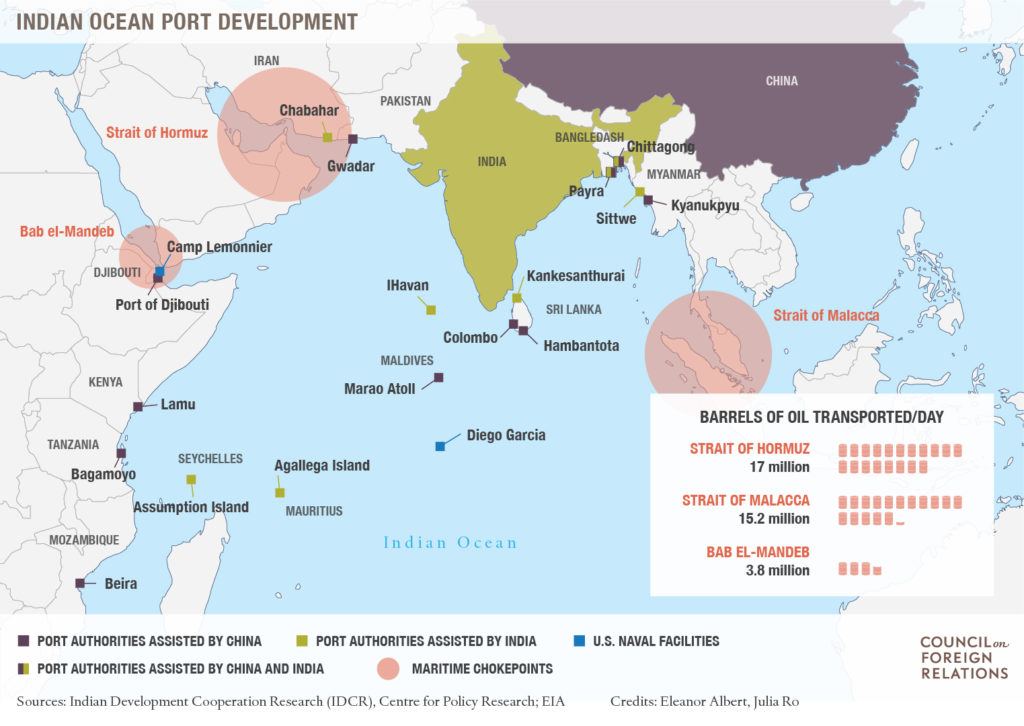
The Indo-Pacific strategy, military alliances like QUAD, and economic alliances such as the Belt & Road Initiative, BIMSTIC, etc., are expanding their focus toward the Indian Ocean. Geopolitics is being utilized to sway small nations to choose between the superpowers, putting small developing island states in the Indian Ocean in a difficult position. Similar to China’s interest in Taiwan in the South China Sea and the U.S. and Russia’s interest in Cuba in the Caribbean Sea, Sri Lanka is a strategic island in the Indian Ocean. Furthermore, Sri Lanka serves as a gateway to the Indian subcontinent, placing it in a position similar to Ukraine’s relation to Russia.
Over the past decade, Sri Lanka has faced challenges in various aspects. When developing much-needed infrastructure like the deep terminal of Colombo Port and the Hambantota Port, as well as other digital infrastructure, external pressure has been exerted by other nations. Additionally, the visits of Yuan Wang 5 vessels and other military vessels to Sri Lankan ports have increased, indicating that similar situations will occur in the future.
China is currently the world’s fastest-growing major economy and is projected to become the largest economy within this decade. In response, the U.S. and its Western allies are actively seeking to curtail China's influence. Meanwhile, India has set its sights on becoming a global economic powerhouse by 2040. These economic shifts will have substantial implications for Sri Lanka and other Indian Ocean nations.
The Like-Minded Group of Indian Ocean (LMGIO)
Sri Lanka should take a leading role in forming a regional coalition called the Like-Minded Group of Indian Ocean (LMGIO)—comprising countries such as Madagascar, Maldives, Seychelles, Djibouti, Mozambique, Comoros, and others to the west and Thailand, Bangladesh, Myanmar, Malaysia, Singapore, Indonesia to the east . This group would maintain a neutral stance in military matters involving India, China, the U.S., and Russia. By excluding major powers, the LMGIO could focus on shared goals, such as enhancing trade and securing development assistance from all global powers on equitable terms.
The LMGIO would serve as a collective voice for island and coastal states in the Indian Ocean, many of which are reluctant to individually express positions due to pressure from larger powers. Through coordinated action, these countries can develop their military capacities, upgrade port infrastructure, and forge joint defense and economic agreements. India, as a key trade hub, and China, as it transitions to high-income status, can offer substantial regional benefits. Free trade within the Indian Ocean is essential for these like-minded states, making the LMGIO a critical platform for sustainable economic engagement.
Structure And Principles Of The LMGIO
The LMGIO would be guided by the foundational principles of the UN Charter, the Vienna Convention, and the United Nations Convention on the Law of the Sea (UNCLOS). Key principles include:
Respect for the sovereignty and territorial integrity of all Indian Ocean nations.
Non-interference in the internal affairs of other countries.
Recognition of each nation’s right to self-defense, individually or collectively, under the UN Charter.
A commitment to non-alignment in any disputes among global powers operating in the Indian Ocean.
Peaceful resolution of international disputes, in accordance with the UN Charter.
Promotion of mutual interests, economic cooperation, and regional stability.
The group would establish specialized committees focusing on security, trade, and infrastructure development. These committees would evaluate the need for technology transfer, capacity building, and funding. LMGIO members would engage in bilateral and multilateral partnerships without participating in or supporting global military or trade conflicts.
Crucially, the LMGIO would empower small island nations to enhance their strategic autonomy by investing in technologies and evidence-based national defense planning. Member states would collaborate to avoid disruptions caused by sanctions or restrictions and work toward maintaining trade neutrality.
The LMGIO could also negotiate as a bloc under international climate frameworks such as the UNFCCC Paris Agreement, helping to secure climate financing and identify infrastructure needs for climate resilience. In parallel, the group should establish diplomatic training and academic programs at national universities to build future expertise in Indian Ocean geopolitics and multilateral diplomacy.

The writer is an Independent Researcher On Maritime Affairs and BRI development. He graduated from Dalian Maritime University, and in 2016 he completed a Master’s Program in Environment and Natural Resources Protection Law at Ocean University of China. He is the Co-Founder of Belt & Road Initiative Sri Lanka (BRISL), an independent and pioneering Sri Lankan-led Organization, with strong expertise in BRI advice and support.
He can be reached via e-mail: info@brisl.org or Twitter – @YRanaraja
