The 80th Anniversary of the United Nations: Reflections on World Order, International Law, and Multilateralism
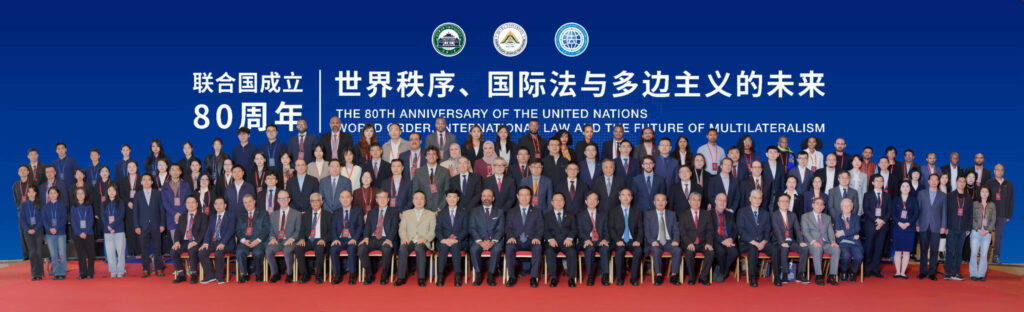
On October 18, the international academic symposium “The 80th Anniversary of the Establishment of the United Nations: The Future of World Order, International Law, and Multilateralism” opened at Wuhan University in Hubei Province. Co-hosted with Benha University of Egypt, the forum gathered an exceptional lineup of diplomats, legal scholars, and policymakers from across the world. Among the distinguished participants were Miguel de Serpa Soares, former Under-Secretary-General for Legal Affairs and UN Legal Counsel; Kamalinne Pinitpuvadol, Secretary-General of the Asian-African Legal Consultative Organization (AALCO); Prof. Anthony Carty, a leading authority in international legal theory; Prof. Kong Qingjiang, Dean of the Academy for Foreign-Related Rule of Law at the China University of Political Science and Law; and Prof. Asif Hasan Qureshi, an expert in international economic law from Peking University’s School of Transnational Law. Also participating were Prof. Alain Wijffels of the University of Leuven (Belgium), Prof. Ralph Wilde of University College London, Dr. David J. Devlaeminck of Chongqing University, and Dr. Yenkong H. Hodu of the University of Manchester.
University leaders and officials attending the opening ceremony included Zhu Kongjun, Party Secretary of Wuhan University; Prof. Nasser Khamis Barakat El-Gizawy, President of Benha University (Egypt); and Dr. Heba Naeim M.E. Hassan, representing Benha University. The presence of the Vice Minister of the Taiwan Affairs Office of the State Council further underscored the symposium’s political and diplomatic significance.
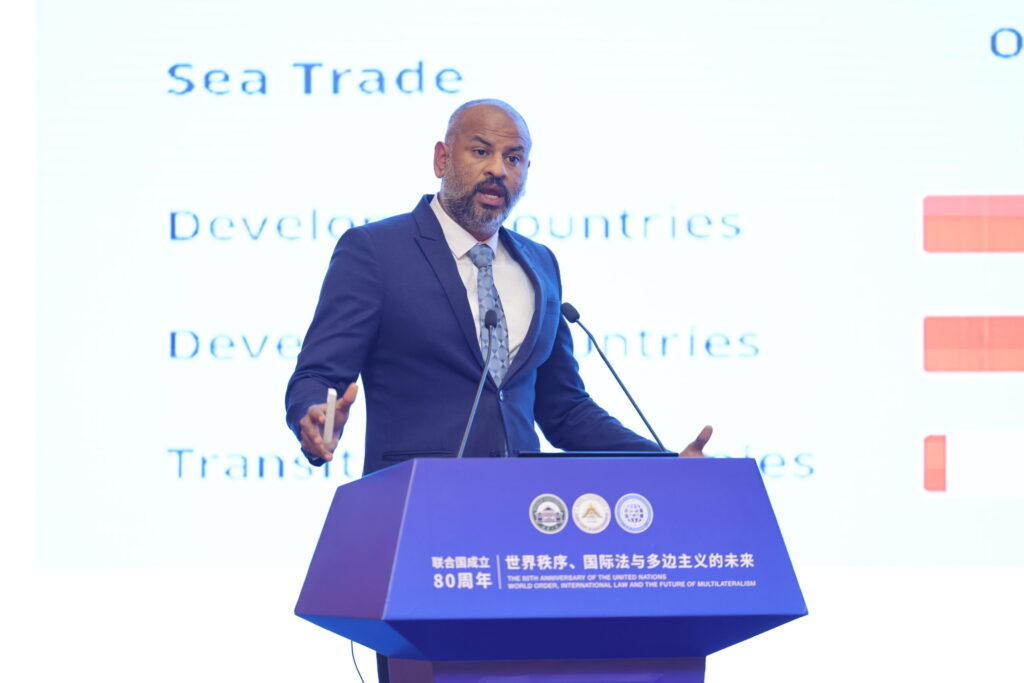
Highlighting the role of International Maritime Oganization in the UN structure Yasiru Ranaraja, Director of the Belt & Road Initiative Sri Lanka (BRISL) and a researcher at the China University of Political Science and Law, delivered a speech on the status of greenhouse gas (GHG) regulations at the International Maritime Organization (IMO), a United Nations’s specialized agency responsible for maritime safety and environmental protection.
Defending the Post-War International Order
Speakers throughout the event emphasized the importance of safeguarding the purposes and principles of the UN Charter, reaffirming that the Cairo Declaration, Potsdam Proclamation, and UN General Assembly Resolution 2758 form the cornerstone of the post-war international order. Discussions highlighted the need to uphold the one-China principle, defend true multilateralism, and preserve the authority of international law as a foundation for global peace and stability.
Yasiru Ranaraja’s Address: “Status of GHG Regulations at the IMO – Strengthening Multilateral Cooperation in an Era of Regulating Emissions from Ships”
In his address, Yasiru Ranaraja explored the growing complexity of maritime emissions regulation within the broader context of international law and climate governance. His presentation, titled “Strengthening Multilateral Cooperation in an Era of Regulating Emissions from Ships”, traced the evolution of global shipping — from ancient wind-powered trade routes to modern two-stroke engines that move over 90% of the world’s merchandise by volume.
He discussed the legal framework governing international waters, referencing MARPOL Annex VI, UNCLOS, and the key principles of No More Favourable Treatment (NMFT) and Common But Differentiated Responsibilities (CBDR). Ranaraja noted that while the Paris Agreement does not directly regulate shipping, the IMO has taken up the challenge by embedding the same spirit of climate equity into its strategy for greenhouse gas reduction.
A significant part of his speech focused on the establishment of the IMO Net-Zero Fund, a new financial mechanism modeled after the Montreal Protocol Fund, aimed at rewarding low-emission innovation, supporting research and infrastructure in developing nations, and funding training and technology transfer. He emphasized that the maritime sector’s transition to cleaner operations must ensure a just and equitable transformation for developing economies and vulnerable states.
“Maritime emissions regulation represents both the complexity and necessity of multilateral cooperation — a true test of the UN system’s ability to balance responsibility with fairness,”
noted Ranaraja during his address.
He concluded by stressing that the IMO’s evolving climate framework reflects the broader challenges of global governance, where climate ambition must coexist with the realities of development and sovereignty — a reminder that the sea, once a channel of civilization and commerce, must now become a channel of climate cooperation.
