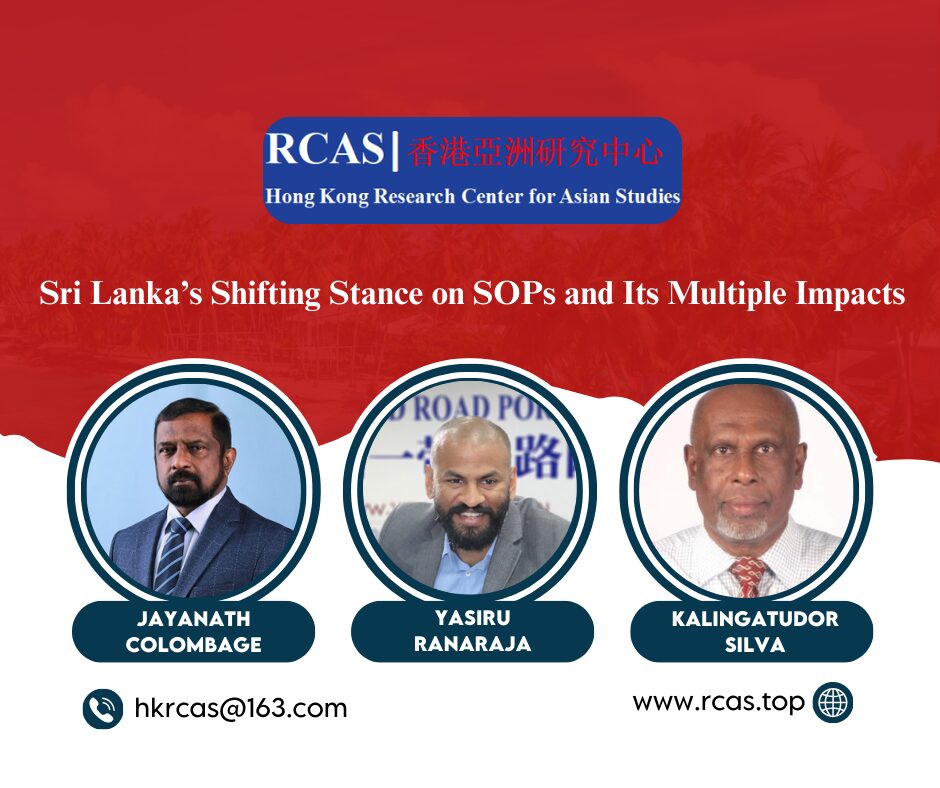
Sri Lanka’s Shifting Stance on SOPs and Its Multiple Impacts
The government of Sri Lanka imposed a moratorium on foreign research vessels for year 2023 and started designing a Standard Operating Procedures (SOPs) to regulate visits by foreign vessels. This committee was headed by the Ministry of Foreign Affairs and comprised of other stake holders in maritime domain. The new government in 2024 wanted to study the SOPs in depth, and this SOP is yet to be finalized and implemented. The main scope of the SOPs would be the need to regulate port visits or engaging in Marine Scientific research by foreign vessels in Sri Lanka’s EEZ so as to monitor and coordinate such activities and to ensure that as far as possible such ships do not pose a threat to national security of any other country in the region.
However, the SOPs would not be able to guarantee adherence to the conditions therein. Sri Lanka will not be able to monitor a research vessel engaged in innocent passage through its EEZ buy carrying our research activities during the passage although such actions are illegal as per the UNCLOS iii. Due to the delay of the implementation of the SOPs, Sri Lanka tend to lose by not engaging in maritime research since these research data would be very valuable in understanding the nature and size of fish stocks, threats to marine eco-systems, impact on global warming and sea level rising and increasing ocean temperature. This lack of oceanic data would hamper the country’s aspirations on embarking on a Blue Economic model of economic development. —Jayanath Colombage, Pathfinder Foundation, Sri Lanka.
Admiral (Prof.) Jayanath Colombage is an Non-resident Senior Fellow at the Hong Kong Research Center for Asian Studies (RCAS), Hong Kong. He has served the Sri Lanka Navy for a period of 36 years and retired as the Commander of the Navy on 01 July 2014. He is the 18th Commander of the Sri Lanka Navy and was decorated for gallantry and commended for exceptional service to the Navy. Email: jayanathskc@yahoo.com.
The core issue with the research vessels in Sri Lanka waters came after the diplomatic protest of India with the arrival of the “Yuan Wang 5” in 2022 which got huge media attention. As Sri Lanka-India maintain a security pact, India questioned how can Sri Lanka guarantee of the security concerns of India when approving such vessels with advance tracking equipment. During the time Sri Lankan authorities didn’t have the capacity to determined such scope for vessels with advance technologies arriving in Sri Lankan waters. Due to this issue, the core concern of the government was, how to regulate such vessels, and ways to draw its strategic autonomy between superpower in such incidents. The core interest of Sri Lankan authorities will be as following: Sovereign Maritime Resources, Illegal Fishing, Naval Modernization. Sri Lanka also enacted new laws and established a National Hydrographic Office under the Ministry of Defence to further this goal and adopt a new Standard Operating Procedures (SOPs) for foreign marine research vessels in a new Act which was introduced last year (National Hydrographic Act No.7 of 2024) and it was envisaged that Sri Lanka would streamline its national approach, capacity build, and improve its sovereign capacity. It also aims to ensure security of sensitive bathymetric data collected from Sri Lankan waters, with the act, the Sri Lanka National Hydrographic Office (SLNHO) was established.
According to the Act, the updated SOPs, which governs the granting of diplomatic clearance for conducting marine research in Sri Lankan waters, its Exclusive Economic Zone (EEZ), and the continental shelf, is aligned with Articles 238 and 265 of the UNCLOS (United Nations Convention on the Law of the Sea) and international law. The SOP covers the approval process for foreign marine scientific research (MSR) vessels to conduct research and dock at Sri Lankan ports. The focus of the State Security Council of Sri Lanka will be on technicalities, such as the ship’s equipment, the required activities in the marine research domain, the areas of research, the results, and ownership of the findings. Besides the geopolitical issues will be addressed in a Cabinet meeting, following consideration of the Security Council’s recommendations.The SOPs regulate all foreign flag vessels entering Sri Lankan waters call at all Lankan ports, for research proposes or for Replenishment or any other purpose. Once the operations procedure is completed it will be presented to the cabinet and parliament was will be adopted as law and further forwarded to respective bodies inducing the foreign missions in Sri Lanka and Lankan missions aboard. Lankan government won’t focus on promoting its legal frameworks and it will be up to the respective nations to follow the updates and new amendments via their respective bodies and missions. Sri Lanka has embarked on a proactive strategy of forging partnerships with key allies to safeguard its territorial waters and assert its sovereignty. Sri Lanka’s partnerships with the United States, Japan, and France encompass a spectrum of initiatives aimed at enhancing maritime security and bolstering capabilities which can be considered as strategic collaborations. By diversifying partnerships and leveraging the expertise of key allies, Sri Lanka seeks to fortify its maritime capabilities, safeguard territorial waters, and uphold regional stability in the Indian Ocean. These collaborative endeavors exemplify Sri Lanka’s commitment to enhancing maritime security cooperation and asserting its role as a key player in the maritime domain. Apart from this, it seems due to varies reasons Sri Lanka is distancing China from its Maritime research programs. -Yasiru Ranaraja, BRISL, Sri Lanka.
Yasiru Ranaraja is an Non-resident Fellow at the Hong Kong Research Center for Asian Studies (RCAS), Hong Kong, as well as Founder and Editor of BRISL (www.brisl.org), a platform dedicated to informed dialogue on China–Sri Lanka cooperation. Email: yasiru.ranaraja@gmail.com.
Sri Lanka’s primary concerns regarding foreign research vessels in its waters revolve around balancing scientific advancement with national security and sovereignty. The lack of comprehensive and transparent Standard Operating Procedures (SOPs) is a critical issue, leading to inconsistent decision-making and creating a vacuum for geopolitical pressures. There’s a legitimate fear that “research” vessels, particularly from major powers, might engage in dual-use activities, gathering intelligence or mapping strategic maritime areas under the guise of scientific exploration. This directly impacts Sri Lanka’s security interests, especially given its strategic location in the Indian Ocean. Furthermore, the repeated delays and cancellations of legitimate scientific collaborations, like the recent FAO vessel incident, highlight how the current uncertainty hinders vital marine research crucial for Sri Lanka’s blue economy and climate resilience efforts. Developing robust, science-based SOPs is crucial for Sri Lanka to assert its sovereign rights while fostering genuine scientific cooperation.
SOPs for foreign research vessels are crucial for ensuring scientific integrity, data standardization, and operational safety. They aim to foster transparent international collaboration while safeguarding national interests, particularly concerning maritime security and resource management. Effective SOPs prevent geopolitical tensions from hindering vital marine research, ensuring ethical conduct and minimizing environmental risks. The comprehensive and transparent SOPs are crucial for Sri Lanka to regulate foreign research vessels effectively. While UNCLOS grants coastal states the right to control research in their EEZ, the lack of finalized and consistently applied SOPs leaves Sri Lanka vulnerable to geopolitical pressures and hinders its ability to leverage scientific cooperation for national benefit. Without clear guidelines, instances of ad-hoc decisions and missed research opportunities will persist. -KalingaTudor Silva, University of Peradeniya, Sri Lanka.
Prof. Kalinga Tudor Silva is the chief editor of the Sri Lanka Journal of Social Sciences and professor emeritus of sociology at the University of Peradeniya, Sri Lanka. He is the author of Decolonization, Email: Kalingatudorsilva@gmail.com.
RCAS Report — Sri Lanka’s Shifting Stance on SOPs and Its Multiple Impacts.
By 香港亞洲研究中心 | The Hong Kong Research Center for Asian Studies (RCAS).
Available at: http://www.rcas.top/report/315.html
About RCAS
香港亞洲研究中心| The Hong Kong Research Center for Asian Studies (RCAS) is a nonprofit research organization focusing on Asian affairs. It is a newly established institution founded in February 2022 by Dr. Nian Peng in Haikou and subsequently moved to Hong Kong in September 2023. We currently have an international research team with nearly 100 resident/nonresident researchers from China and other countries.
RCAS aims to become a leading research institute and think tank on Asian affairs in the Indo-Pacific region. To date, RCAS has conducted research programs on maritime disputes in the South China Sea (SCS), China’s relations with the Indo-Pacific states, the Belt and Road Initiative (BRI), terrorism/counterterrorism in the Afg-Pak region, and so on. It is committed to promoting maritime cooperation, regional integration, and regional peace in the Indo-Pacific region at large.
RCAS has published nearly ten books in Chinese and English and more than 20 papers in SSCI/SCOPUS/CSSCI-indexed journals. Recent English publications include Populism, Nationalism and South China Sea Dispute: Chinese and Southeast Asian Perspectives (Singapore: Springer Nature, 2022); Pakistan’s Foreign Policy: Contemporary Developments and Dynamics (London: Routledge, 2022); Crossing the Himalayas: Buddhist Ties, Regional Integration and Great-Power Rivalry (Singapore: Springer Nature, 2021); The Reshaping of China-Southeast Asia Relations in Light of the COVID-19 Pandemic (Singapore: Springer Nature, 2021); Territorial Disputes, The Role of Leaders and The Impact of Quad: A Triangular Explanation of China-India Border Escalations (2023); Managing the South China Sea Dispute: Multilateral and Bilateral Approaches (2022); China-Pakistan Cooperation on Afghanistan: Assessing Key Interests and Implementing Strategies (2022); Hedging Against the Dragon: Myanmar’s Tangled Relations with China since 1988 (2021); and China-Pakistan Conventional Arms Trade: An Appraisal of Supplier’s and Recipient’s Motives (2020).
RCAS has also published hundreds of articles, and its researchers have been interviewed in various local and international media outlets, such as The Diplomat in the United States, East Asian Forum (EAF) in Australia, Bangkok Post in Thailand, Jakarta Post in Indonesia, Lian He Zao Bao, Think China in Singapore, South China Morning Post (SCMP), China-US Focus in Hong Kong, CGTN, Global Times, World Affairs in China. RCAS researchers have actively participated in international conferences or study visits in the United States, India, Pakistan, Sri Lanka, Nepal, Myanmar, Cambodia, and other places.
Welcome to visit our website: http://www.rcas.top.
Address: 1507B, EASTCORE1, No.398, Kwun Tong, Kooloon, Hong Kong
Ph: 00852 2397 7886| Email: hkrcas@163.com| Web: www.rcas.top
